Structural Concrete That Supports Permanent Loads
Foundation & Slab Services in Rock Hill for new construction requiring level structural support
Rock Hill properties with expansive clay soil experience seasonal foundation movement that shows up as sticking doors, cracked drywall, and uneven floors. Heritage Excavation & Concrete LLC pours house slabs, garage foundations, and building slabs with reinforcement specifications and compacted base preparation designed to resist that movement. The difference between a slab that cracks within two years and one that remains stable for decades comes down to soil preparation depth, reinforcement placement, and concrete mix design that accounts for local soil conditions.
Foundation work begins with excavation to undisturbed soil or engineered fill compacted in controlled lifts, followed by a vapor barrier that prevents ground moisture from migrating up through the concrete and damaging flooring materials. Accurate leveling using laser transits positions the finished slab height within one-eighth inch across the entire surface, critical for garage doors that bind if the floor slopes incorrectly and for homes where flooring contractors expect a flat substrate.
Arrange an on-site consultation to review soil conditions and discuss reinforcement requirements for your building project.
How Foundation Slabs Handle Structural Demands
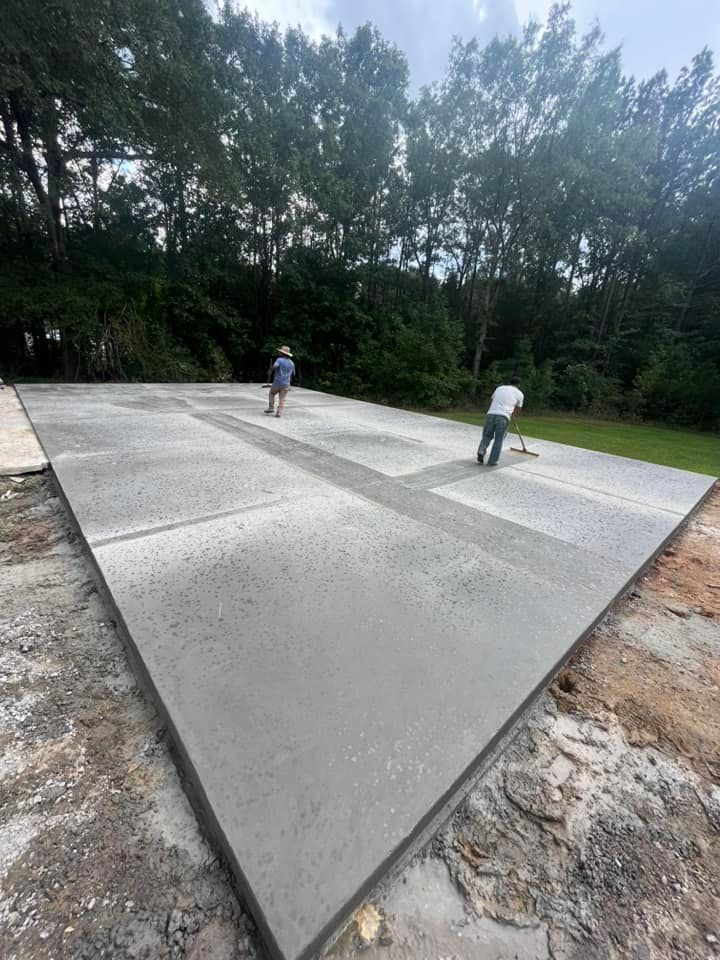
Load-bearing slabs require steel reinforcement sized according to the structure above, with rebar grids spaced at twelve or eighteen inches depending on whether the slab supports residential loads or heavier garage equipment. The concrete remains workable for approximately ninety minutes after mixing, during which crews place, screed, and finish the entire pour without cold joints that create weak planes where cracks initiate. Forming systems hold the slab perimeter rigid during the pour and establish the exact elevation for door thresholds and wall plates.
After the concrete reaches full strength, your structure rests on a monolithic slab that distributes building loads across the entire footprint rather than concentrating weight on perimeter footings. The surface accepts tile, hardwood, or carpet installation without requiring additional underlayment, and the vapor barrier underneath prevents the moisture problems that cause wood subfloors to rot in crawlspace foundations.
Slab services include excavation, forming, reinforcement, concrete placement, and finishing to the specified surface texture, but plumbing penetrations and electrical conduit placement require coordination with your contractor before the pour. The curing period requires protection from traffic and rain for at least three days, longer in cold weather when hydration slows.
Common Questions About This Service
Property owners planning foundation work usually want to know about soil preparation steps, reinforcement specifications, and how Rock Hill's clay soil affects the long-term performance of concrete slabs.
What thickness does a garage slab need?
Residential garage slabs typically run four inches thick with wire mesh reinforcement, but slabs supporting vehicle lifts or heavy equipment require six-inch thickness with rebar grids designed for the specific load.
How does clay soil in Rock Hill affect foundation stability?
Expansive clay shrinks during dry periods and swells when saturated, creating uplift pressure under slabs, which is why proper compaction and moisture barriers are non-negotiable for long-term stability.
When can framing begin after the slab is poured?
Framing crews can anchor sill plates after three days when the concrete has sufficient strength for anchor bolts, though full structural capacity develops over the following weeks.
What causes slabs to crack even with reinforcement?
Most cracking results from inadequate base preparation that allows settling, or from restraint at plumbing penetrations where the slab cannot move freely during curing shrinkage.
How is the finished floor height determined?
The slab elevation is set by door thresholds, existing grade, and drainage requirements, typically four to six inches above surrounding soil to keep water away from the building perimeter.
Heritage Excavation & Concrete LLC provides forming accuracy and reinforcement placement that meet residential and commercial building codes throughout Rock Hill. Contact us to schedule foundation work coordinated with your construction timeline.